Private by default
The actor’s
private working room.
Keep the audition. Build the character. Learn the lines. Run the scene. Save what you discover.
Nothing here is public unless you publish it · OCT 22, 2026
start where you are.
p. 01
- Private by default.
- Use what helps. Ignore what doesn't.
- The actor decides what works.
- Keep the work.
- Run it again.
- Make a mess.
Inside OFF BOOK
Everything around the work, in one place.
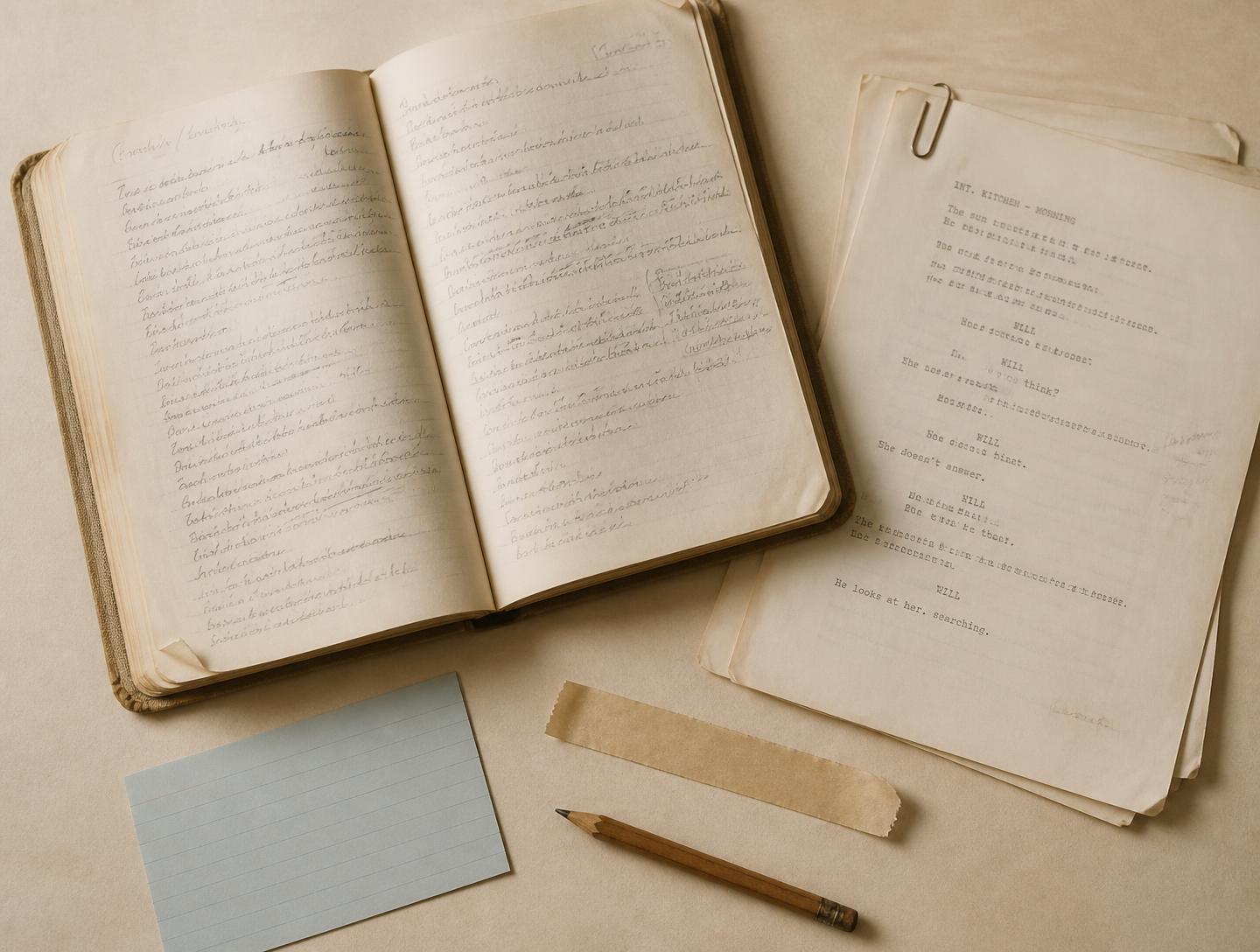
Not six identical screens. A folder for the audition, a book for the character, a marked-up side, a run of the scene, a strip of takes, a note written far too late.
Untitled character
What do I want?
a note in the margin, in your hand
A blank side showing the highlight and underline tools you use to mark your own pages.
mark it up however you work
New audition
Type
Due
Sides
Status
everything about it, in one folder
Select the one to send
compare, choose, keep the note why
whatever the work teaches you at 1 AM
Keep with a character · a scene · a tape
The way it actually goes
The audition arrives. Then the work starts.
OFF BOOK is arranged around the order things really happen in — not around tidy software categories.
- 01
Get the audition
One folder holds the whole thing: who's casting, what's due and when, the sides, the character you're building, your preparation, the tape you send and whatever comes back. Nothing living in four different apps.
- Audition details
- Deadline
- Sides
- Character
- Preparation
- Self-tape
- Callbacks
- 02
Do the work
The part nobody sees. A book for the character that fills up slowly, scripts you can scribble over, scene and beat work, monologues you keep ready, and a notebook for everything in between.
- Character Books
- Scripts & Sides
- Scene work
- Rehearse
- Monologues
- Notebook
- 03
Run it
Hide your lines, work the cues, ask for the line when it goes, and run the difficult ones again. On your own, as many times as it takes.
- Cue lines
- My lines hidden
- Line?
- Again
- Needs work
- Pick it back up
- 04
Keep the tape
Takes stay together with your notes on them. Compare two, label them, mark the one you sent, and keep the ones you didn't.
- Multiple takes
- Notes
- Compare
- Selected take
- What you sent
- 05
Keep what you discover
The note at 1 AM, the performance you keep returning to, the image that unlocked a character, the thing you learned that belongs to no single job.
- Notebook
- Inspiration
- Watch & Study
- Things I've learned
Run it
No scene partner around?
Run it anyway.
Bring in a script, a side or a monologue and work it on your own. Cue lines stay visible while yours are covered. Ask for “Line?” when it goes, take the cue again, mark the ones that keep slipping, and pick the run back up tomorrow where you dropped it.
- Your lines hidden, cues in view — reveal one at a time.
- Line? gives you the next few words, not a telling-off.
- Again repeats the cue as many times as you need.
- Nothing is scored. Nothing is graded. Nothing is timed against you.
Read-aloud and voice notes use your own device’s built-in speech and microphone. Optional, and only if your browser supports them.
A blank side showing the highlight and underline tools you use to mark your own pages.
mark it up however you work
Select the one to send
compare, choose, keep the note why
Keep the tape
Four takes. Almost the same. Completely different.
Put every take in one place, label them, and watch two side by side. Write what worked and what you’d change while it’s still fresh. Mark the one you sent, keep the rest, and come back to them after the callback — or after the year.
you decide which one is the take.
Keep what you discover
The 1 AM note is the point.
Notes, images, performances you keep returning to, and the things you learn that have nothing to do with any one job.
01
Notebook
Write one sentence and close it. It saves itself, and it can sit with the character or scene it belongs to.
02
Inspiration
Boards of images, quotes, links and sounds — kept privately, and attachable to a character.
03
Watch & Study
What you want to watch, what you watched, and the specific choice you noticed in it.
04
Things I've learned
The lines that outlast the job. Sent here from anywhere and kept in one list.
People I’ve been
Some characters leave.
Some don’t.
Every character you build, every audition that came and went, every tape and note and discovery quietly stays. Years later it’s a private record of an acting life: who you’ve been, what you tried, what you found out. Nobody sees it but you.
Untitled character
What do I want?
a note in the margin, in your hand
Year · Medium
every one you keep, kept
Play
Make a mess.
Not everything has to be for an audition. Play is for experimenting, warming up, getting unstuck and trying something strange.
Privacy
Your work is your work.
OFF BOOK is private by default. Your auditions, scripts and sides, annotations, character books, rehearsals, tapes, notes, calendar and everything you keep are yours alone. There is no feed, no sharing by accident, and no way for another actor to browse your work.
A simple public actor page is available if you want something to send to a casting office. It is switched off until you turn it on, it lives at its own link, and only the specific lines you tick ever appear on it. Your workspace can never be published — there is no switch for it. You can take the page down, or delete your account and everything in it, whenever you like.
On the public page
- Only the fields you tick
- Off until you publish it
- Its own link, taken down any time
Never on it
- Auditions
- Scripts, sides and notes
- Tapes, rehearsals, characters
For actors
If you're working on something, it's for you.
There's no tier for professionals and no beginner mode. It's the same working room whether you're in rehearsals, in class, or figuring out a monologue at the kitchen table.
- Working actors
- Actors starting out
- Acting students
- Theatre actors
- Film and TV actors
- Actors living in self-tapes
- Performers building a craft
- Anyone with a monologue to learn
Not another productivity app
You are not a KPI.
- No acting score.
- No booking-rate obsession.
- No streaks to keep alive.
- No leaderboard.
- No algorithm deciding whether a performance was good.
OFF BOOK gives you somewhere to work. You decide what works.
FAQ
Straight answers.
What is OFF BOOK?
A private working space for the actual process of acting: auditions, character work, scripts and sides, learning lines, self-tapes, rehearsal, notes, inspiration, play, and the record of everything you've done.
Who is it for?
Any actor with work in front of them — professional, student, stage, screen, or somewhere in between. There's no separate beginner version.
Is my work private?
Yes. Everything you keep is tied to your account and only reachable by you. An optional public actor page exists, it's off until you switch it on, and only the fields you tick appear on it.
Can I upload scripts and sides?
Yes — PDFs or typed and pasted text. You can mark them up with highlights, underlines, margin notes and symbols, break them into scenes and beats, and mark your lines and cue lines.
Can I use it for self-tapes?
Yes. Upload your takes, label them, add notes, compare two side by side and mark the one you submitted. Files stay private to your account.
Can OFF BOOK help me learn lines?
That's what Rehearse is for: your lines hidden, cues in view, Line? when it goes, Again to repeat the cue, and a mark on the ones that keep slipping. Reading lines aloud uses your own device's built-in speech, if your browser supports it — there's no synthetic scene partner pretending to act with you.
Do I have to use every feature?
No. Use what helps and ignore the rest. Nothing nags you for leaving a section empty.
Can I use it on my phone?
Yes. It's built for phone, tablet and desktop — including reading sides, running lines and recording notes on a phone.
Can I use OFF BOOK if I'm still an acting student?
Yes, and class work is exactly what a lot of it is for: scene study, monologues, character books and the notes from a teacher you don't want to lose.
Can I delete my data?
Yes. Archive things you want out of the way, restore them later, and delete for good when you mean it. Deleting your account removes your work and your uploaded files with it.
One more thing
There’s always another scene.
Keep somewhere to come back to.